
When a commercial roof begins showing signs of age, replacement isn’t always the only option. Roofing Coatings can provide a restoration path for certain existing roofs, while complete replacement offers a more comprehensive solution when the current assembly has reached the point where restoration no longer makes sense. The challenge is determining which situation you’re actually dealing with.
Choosing between these approaches shouldn’t come down to which one sounds less expensive or more permanent. Existing membrane condition, moisture, adhesion, drainage, insulation, flashing, substrate integrity, and the extent of deterioration all matter. A coating can be an effective strategy on the right roof, but it should never be used to hide problems that require more substantial corrective work.
Overview: Restoration or Replacement?
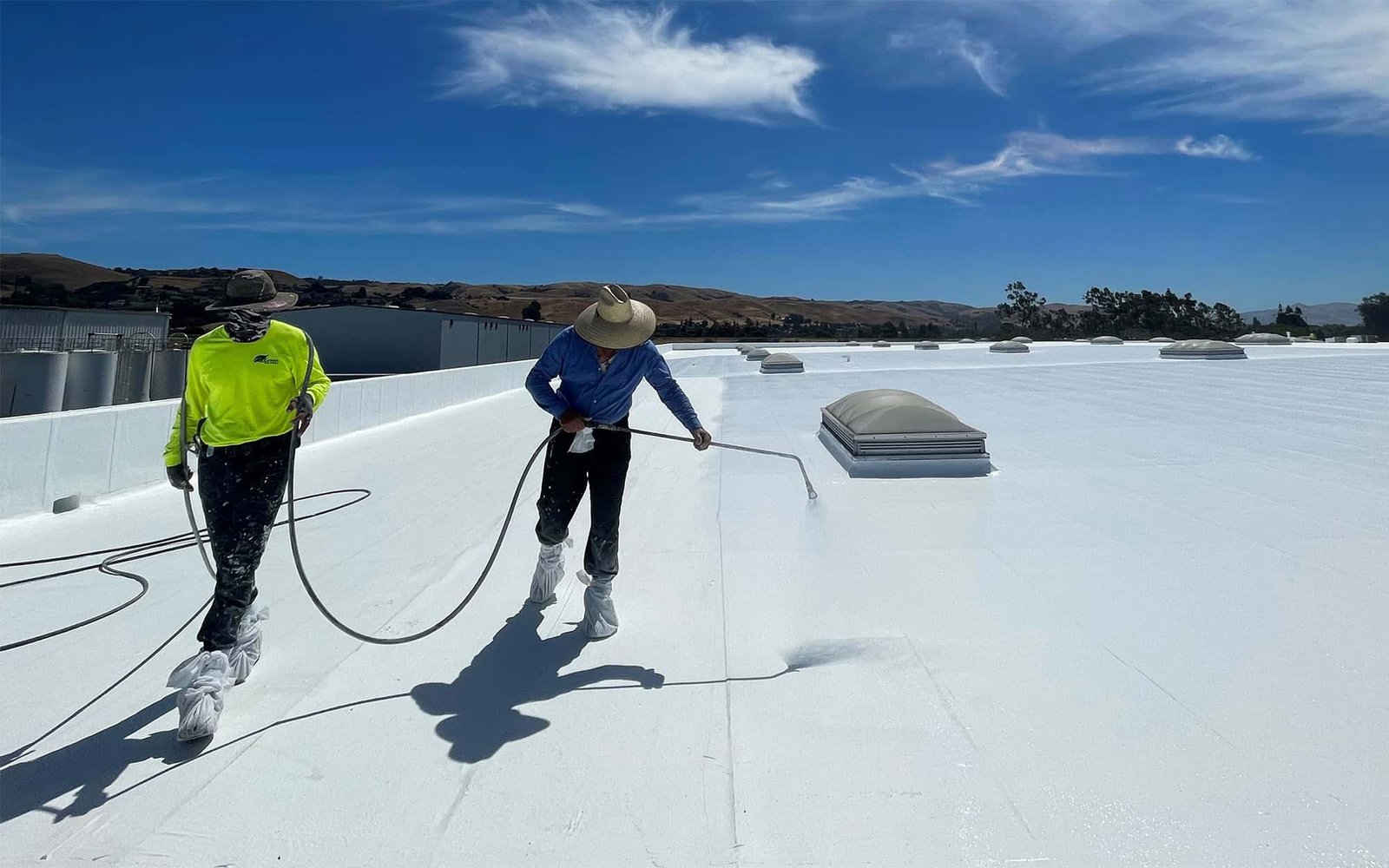
Roof coating and roof replacement solve different problems. A restoration coating works with an existing roof that has been evaluated and found suitable for the specified system. Preparation and localized repairs are completed first, after which the compatible coating becomes part of a renewed protective surface.
Replacement takes a broader approach. Existing roofing components are removed or otherwise addressed according to the project design, underlying conditions can be evaluated, and a new roofing assembly is installed. This gives the project team greater opportunity to address deficiencies that cannot reasonably be corrected from the surface.
| Factor | Roof Coating / Restoration | Roof Replacement |
|---|---|---|
| Existing Roof | Must be an appropriate restoration candidate | Can address roofs requiring more extensive intervention |
| Project Scope | Preserves much of the existing assembly | Creates a new roofing assembly according to project requirements |
| Underlying Problems | Suitability depends heavily on existing conditions | Provides greater opportunity to address widespread deficiencies |
| Installation Disruption | Often less extensive when conditions qualify | Typically a larger construction project |
Option A: Roofing Coatings and Restoration
A coating strategy begins with a deceptively simple question: Is the existing roof worth preserving? If the answer is yes, restoration can allow serviceable portions of the assembly to remain while identified deficiencies are corrected and an appropriate coating system is applied.
Preparation is critical. The roof may require cleaning, localized repairs, attention to seams or flashing, treatment of penetrations, and other system-specific preparation before coating application. The exact process depends on the existing roof and the coating manufacturer’s requirements.
Moisture also matters. A roof should not simply be coated because its surface looks weathered. Suspected moisture within the assembly, widespread deterioration, unstable substrates, or unresolved drainage problems can change whether restoration is appropriate.
Pros of Roof Coating / Restoration
- Preserves suitable portions of the existing roof.
- Can involve less extensive construction than complete replacement.
- Provides a renewed protective surface when properly specified.
- Can address localized deficiencies as part of the preparation process.
Cons of Roof Coating / Restoration
- Not every existing roof qualifies.
- Cannot compensate for unsuitable underlying conditions.
- Requires careful surface preparation and material compatibility.
- Drainage and moisture problems must still be addressed.
Roof Coating / Restoration has the advantage when the existing assembly remains suitable, deficiencies can be corrected, and the roof meets the requirements of the proposed coating system.
A qualified Roof Coating Contractor should therefore evaluate the roof before recommending a coating—not simply quote the application based on roof area. The assessment should consider compatibility, surface condition, flashing, penetrations, drainage, previous repairs, and indications that further moisture investigation may be appropriate.
Option B: Full Roof Replacement
Replacement becomes the stronger strategy when the existing roof can no longer provide a reasonable foundation for restoration. Widespread deterioration, extensive moisture-related concerns, unsuitable substrates, recurring failures, or conditions that cannot be adequately corrected through surface preparation may shift the decision toward a new roofing assembly.
Replacement also creates an opportunity to reconsider the roof as a complete system. Insulation, drainage, flashing, penetrations, attachment, perimeter conditions, and the primary roofing material can all be evaluated against the building’s current requirements rather than simply reproducing the previous design.
Pros of Roof Replacement
- Provides a comprehensive approach to significant deterioration.
- Allows underlying conditions to be addressed according to project scope.
- Creates an opportunity to update insulation and roof-system design.
- Allows the roofing technology to be reconsidered for current building needs.
Cons of Roof Replacement
- Generally involves a larger construction scope.
- Can create greater logistical demands for occupied properties.
- May require more extensive removal, staging, and coordination.
- Is unnecessary when an existing roof remains a sound restoration candidate.
Roof Replacement is the stronger path when existing conditions cannot reasonably support a coating/restoration strategy.
Side-by-Side Comparison: Which Strategy Fits Which Roof?
The biggest mistake in this comparison is treating roof coating as the inexpensive option and replacement as the expensive option without first considering roof condition. Cost matters, but it comes after eligibility. If the existing assembly is not suitable for restoration, choosing a coating simply because the initial project is less extensive can postpone rather than solve the underlying roofing problem.
Start by asking what the existing roof actually needs. A generally serviceable assembly with correctable surface deficiencies presents a very different decision from a roof with widespread deterioration or significant concerns below the visible surface.
| Building / Roof Condition | Roof Coating | Roof Replacement | Likely Better Direction |
|---|---|---|---|
| Existing roof generally serviceable | Potentially well suited after proper evaluation | May represent unnecessary scope | Coating deserves consideration |
| Localized correctable deficiencies | Repairs may be incorporated into preparation | Possible, but may be more extensive than necessary | Evaluate restoration first |
| Significant suspected moisture | Requires investigation before eligibility can be determined | May provide a more appropriate path when affected materials are extensive | Condition testing decides |
| Widespread deterioration | Often a poor candidate if the substrate cannot support restoration | Can address the broader assembly | Replacement |
| Major insulation or assembly changes needed | Limited ability to fundamentally redesign the assembly | Greater opportunity for system redesign | Replacement |
| Reducing construction scope is a priority | Can offer a less extensive project when roof conditions qualify | Usually requires greater project coordination | Coating, if eligible |
Roof Coating / Restoration generally has the advantage because suitable existing roofing components can remain in place and the project scope may be less extensive.
Roof Replacement has the advantage when the project needs substantial changes to insulation, damaged underlying materials, or other major components of the roofing assembly.
Drainage is one area where neither strategy should receive an automatic win. If water is not moving toward drains and scuppers as intended, that condition needs to be evaluated regardless of whether you restore or replace the roof. Applying a coating over an unresolved drainage problem doesn’t make the problem disappear, while installing a new roof without reconsidering recurring drainage deficiencies can carry an old issue into a new system.
Flashing and penetrations require similar attention. HVAC curbs, vents, walls, perimeter transitions, and other interruptions in the roof field must be integrated into the waterproofing strategy. A coating project may require repair or reinforcement at these details before application; a replacement project provides the opportunity to rebuild them as part of the new assembly.
Choosing the Right Path for Your Commercial Roof
So, which option wins? Neither one wins universally. The condition of the existing roof determines which strategy deserves the advantage.
If the roof remains fundamentally serviceable, compatible with the proposed coating, and free from conditions that make restoration inappropriate, coating can preserve usable roofing materials while renewing the protective surface. That can make it a compelling option for owners who want to avoid unnecessary removal and reduce the scope of construction.
If deterioration extends beyond what preparation and localized repair can reasonably correct, replacement becomes the stronger choice. The same is true when significant underlying materials need to be addressed or when the property requires broader changes to the roofing assembly.
| Decision Priority | Winner | Why |
|---|---|---|
| Preserve a suitable existing assembly | Roof Coating | Restoration works with roofing components that remain serviceable. |
| Address widespread deterioration | Replacement | Provides a broader corrective scope. |
| Reduce construction scope | Roof Coating | Can retain suitable portions of the existing assembly. |
| Redesign major roof components | Replacement | Offers greater flexibility to modify the complete assembly. |
| Roof condition is uncertain | Neither—Inspect First | A reliable recommendation requires evidence about existing conditions. |
When the roof is serviceable and compatible, coating wins for preservation. When deterioration or underlying deficiencies are extensive, replacement wins for comprehensive correction. If roof condition has not been established, inspection should come before either recommendation.
The best next step is therefore not to ask, “How much does coating cost compared with replacement?” Start with, “Is this roof actually a good candidate for restoration?” That one question changes the entire comparison.
Once you understand the membrane condition, moisture concerns, drainage, flashing, substrate, insulation, and repair history, the choice becomes much clearer. Instead of buying the least disruptive option or automatically choosing the most extensive one, you can select the strategy that solves the problem your building actually has.