

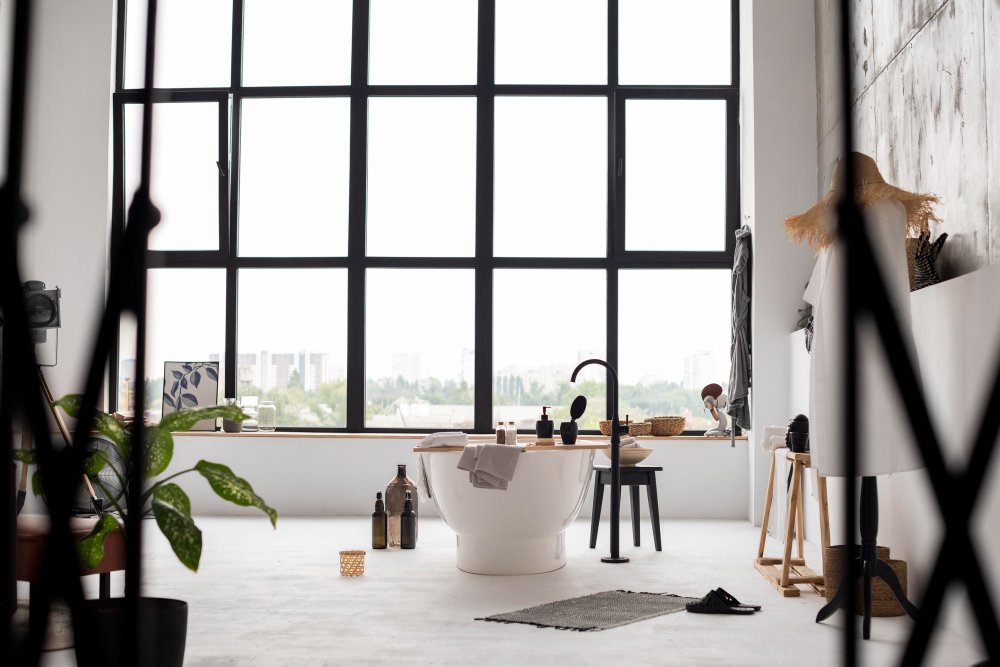
A thoughtfully selected bathroom window can improve far more than the room’s appearance. It influences natural light, privacy, airflow, condensation control, maintenance requirements, and year-round comfort. Because bathrooms regularly experience warm air, steam, and changing humidity levels, the window must perform under more demanding conditions than a typical bedroom or living room window.
The best choice is not necessarily the largest or most expensive model. A compact awning window may outperform a larger fixed window when ventilation is the priority. In another bathroom, a high-mounted fixed window with privacy glass may provide better daylight without using valuable wall space near the vanity.
This guide compares window styles, glass options, frame materials, energy-performance features, and placement strategies so homeowners can choose a solution based on measurable priorities rather than appearance alone.
FACT: A Bathroom Window Has Four Primary Jobs
| Daylight | Reduces dependence on electric lighting during daytime hours. |
| Privacy | Limits exterior visibility without making the room feel enclosed. |
| Ventilation | Allows fresh air to enter and warm, humid air to escape. |
| Thermal Control | Helps limit unwanted heat transfer and cold interior glass surfaces. |
Why Bathroom Windows Affect More Than Natural Light
Condensation forms when warm, moisture-heavy bathroom air contacts a cooler surface. Window glass is often one of the coldest interior surfaces in the room, so it may fog or collect water before the walls and ceiling show visible moisture. Occasional fogging after a shower is not unusual, but persistent water on the glass, frame, or sill can indicate insufficient ventilation, poor insulation, or both.
An operable window can support natural airflow, but it should not automatically replace a properly designed exhaust system. A window only ventilates the room when it is open, outdoor conditions are suitable, and air can move effectively through the space. In high-use bathrooms, window ventilation and mechanical exhaust work best as complementary systems.
Window placement also affects functionality. A low clear-glass window may create privacy problems, while an oversized window can eliminate wall space needed for mirrors, lighting, storage, or a shower enclosure. A high-mounted window, clerestory opening, or transom can bring daylight deeper into the room while reducing direct sightlines from outside.
| Performance Factor | What to Evaluate | Warning Sign | Practical Response |
|---|---|---|---|
| Humidity | How quickly steam clears after bathing | Wet glass or sill remains long after use | Improve exhaust and select an operable window |
| Privacy | Views from streets and neighboring properties | Blinds must remain closed all day | Use privacy glass or raise the opening |
| Daylight | Brightness across the vanity and shower | The room requires lights throughout the day | Increase glazing area or improve placement |
| Energy Performance | Drafts, glass temperature, and solar exposure | Cold drafts or repeated interior condensation | Consider insulated Low-E glazing and better sealing |
Comparing the Most Useful Bathroom Window Styles
Window operation determines how much air can move through the opening, how easy the unit is to clean, and whether it conflicts with nearby fixtures. For example, an outward-opening casement window may provide excellent airflow but could be inconvenient where exterior clearance is limited. A sliding unit does not project outward, although only part of the opening provides ventilation.
| Window Style | Airflow | Privacy Potential | Cleaning | Space Needed | Best Application |
|---|---|---|---|---|---|
| Awning | Excellent | High | Easy | Low wall area | Small bathrooms and high wall placement |
| Casement | Excellent | Medium | Easy | Exterior clearance | Rooms where maximum natural airflow matters |
| Sliding | Moderate | Medium | Moderate | Wide opening | Contemporary bathrooms with horizontal wall space |
| Fixed | None | Very High | Very Easy | Flexible | Bathrooms with reliable mechanical exhaust |
| Double-Hung | Good | Medium | Easy with tilt-in sash | Vertical wall area | Traditional homes and replacement projects |
| Skylight | Varies | Excellent | More Difficult | Roof access | Bathrooms with limited exterior wall space |
Best overall for a small bathroom: a high-mounted awning window. It uses limited wall space, provides useful airflow, and can be paired with obscure glass.
Best for maximum daylight: a fixed window or skylight. Because neither guarantees ventilation, mechanical exhaust becomes especially important.
Best for maximum natural ventilation: a casement window. Its sash opens widely and can direct moving air into the room, provided there is enough exterior clearance.
DECISION RULE
Do not select a window style based only on how it looks when closed. Confirm how far it opens, whether the handle remains reachable, what it may hit inside or outside, and how the exterior surface will be cleaned.
Which Glass Provides Privacy Without Sacrificing Daylight?
Privacy treatments do not all perform the same way. Frosted and obscure glass diffuse views through the pane while allowing daylight to enter. Decorative textured glass can become a design feature, but the pattern should be evaluated from both sides and under nighttime lighting. Some glass that appears private during the day may reveal silhouettes when the bathroom is illuminated after dark.
Clear glass may work when the window faces a fully private yard, sits above normal sightlines, or uses landscaping as a visual barrier. Window film is an affordable retrofit option, although its durability and appearance depend on product quality, glass condition, exposure, and installation.
| Privacy Option | Daylight | Daytime Privacy | Nighttime Privacy | Maintenance | Best Use |
|---|---|---|---|---|---|
| Frosted Glass | High | Excellent | High | Low | Most primary and family bathrooms |
| Obscure Glass | High | Very Good | Varies by pattern | Low | Bathrooms needing permanent privacy |
| Textured Glass | Medium to High | Good | Pattern-dependent | Low | Decorative or traditional interiors |
| Privacy Film | Medium to High | Good | Varies | Moderate | Budget-friendly upgrades to existing glass |
| Clear Glass | Maximum | Low | Low | Moderate | Secluded properties or high clerestory windows |
PRIVACY TEST
Before approving a glass sample, view it from the exterior while the interior lights are on. Check it from several distances and angles. This simple test is more useful than evaluating the glass only under showroom lighting.
Frame Materials, Energy Efficiency, and Moisture Resistance
The frame is exposed to recurring humidity, cleaning products, and occasional splashing. Vinyl is commonly selected because it requires limited maintenance and does not need repainting. Fiberglass provides dimensional stability and strong performance but may cost more. Aluminum offers narrow sightlines and a modern appearance, although thermal performance depends heavily on the frame design. Wood creates a warm, traditional look but requires careful sealing and ongoing inspection in a moisture-prone room.
| Frame Material | Moisture Resistance | Maintenance | Thermal Potential | Relative Cost | Key Consideration |
|---|---|---|---|---|---|
| Vinyl | High | Low | Good | $–$$ | Practical choice for most bathrooms |
| Fiberglass | High | Low | Very Good | $$$ | Strong dimensional stability |
| Aluminum | High | Low | Design-dependent | $$–$$$ | Confirm thermal-break construction |
| Wood or Wood-Clad | Moderate | Higher | Very Good | $$$–$$$$ | Inspect coatings, joints, and interior trim regularly |
Glass performance is equally important. Double-pane insulated glazing generally provides better thermal control than single-pane glass. Low-emissivity coatings can help manage heat transfer and solar exposure, while warm-edge spacer systems and well-insulated frames may improve the interior surface temperature near the glass edge.
Triple-pane glazing can deliver additional insulation, but it is not automatically the best value for every bathroom or climate. The complete window—including frame, glass, spacer, seals, installation, orientation, and size—should be evaluated as one system.
| Glazing Configuration | Insulation | Condensation Resistance | Weight | Relative Cost | Best Fit |
|---|---|---|---|---|---|
| Single Pane | Low | Low | Low | $ | Limited retrofit situations |
| Double Pane | Good | Good | Moderate | $$ | Most residential bathroom replacements |
| Double Pane with Low-E | Very Good | Very Good | Moderate | $$–$$$ | Balanced efficiency and cost |
| Triple Pane | Excellent | Excellent | Higher | $$$–$$$$ | Cold climates or high-performance projects |
Common Bathroom Window Mistakes and Better Solutions
The most expensive window can still underperform if its location, installation, or ventilation strategy is poorly planned. Review the following risks before finalizing the design.
COMMON MISTAKES
- Using a fixed window as the only moisture-control strategy. A fixed unit supplies light but no natural airflow.
- Choosing glass based only on daytime privacy. Interior lighting can make silhouettes more visible after dark.
- Placing an operable sash behind a faucet or deep countertop. The handle may become difficult to reach.
- Ignoring direct shower exposure. The opening, sill, trim, and surrounding waterproofing require careful detailing.
- Selecting untreated interior wood components. Repeated moisture can damage poorly protected materials.
- Assuming a larger window is always better. Oversizing may reduce privacy, storage, mirror space, and thermal comfort.
Bathrooms with windows inside or immediately beside a shower require special attention. Glass safety requirements, sill design, waterproofing, flashing, sealants, trim materials, and local building regulations should be reviewed before installation. A flat sill that holds water is less desirable than a properly detailed surface that directs moisture away from vulnerable joints.
Accessibility also matters. A window that requires stretching over a tub or climbing into a shower is unlikely to be opened regularly. Controls should be reachable, simple to operate, and positioned where they do not interfere with grab bars, shower glass, mirrors, or storage.
Choosing the Best Bathroom Window for Your Home
There is no single window that is best for every bathroom. The right choice depends on which performance problem needs to be solved first. Begin with privacy and ventilation, then evaluate daylight, maintenance, energy performance, style, and budget.
| Your Main Priority | Recommended Starting Point | Important Qualification |
|---|---|---|
| Maximum Privacy | High awning window with frosted or obscure glass | Test nighttime visibility before ordering |
| Maximum Ventilation | Casement or awning window | Confirm reach and exterior clearance |
| Maximum Daylight | Large fixed window or skylight | Provide reliable mechanical exhaust |
| Low Maintenance | Vinyl or fiberglass frame with fixed or simple operable sash | Keep tracks and drainage paths clean |
| Small Bathroom | Compact high-mounted awning or clerestory window | Protect mirror and storage space |
| Luxury Design | Large privacy-glass feature window plus a separate operable section | Balance visual impact with privacy and solar exposure |
STATISTICAL-STYLE PERFORMANCE SUMMARY
- Operable vs. fixed: only operable windows provide direct natural ventilation.
- Single vs. insulated glazing: insulated units generally provide stronger thermal performance and warmer interior glass surfaces.
- Clear vs. privacy glass: clear glass maximizes views, while frosted and obscure glass prioritize privacy.
- Low vs. high placement: higher openings usually reduce direct sightlines and preserve usable wall space.
- Window alone vs. combined ventilation: pairing an operable window with mechanical exhaust provides more dependable moisture management.
Maintenance Practices That Protect Long-Term Performance
Inspect the window periodically rather than waiting for visible damage. Clean condensation from the glass and sill, keep weep holes and drainage paths open, and remove dust or debris from tracks and hardware. Look for cracked sealant, peeling finishes, soft wood, staining, or gaps where the frame meets surrounding materials.
After showering, use the exhaust fan and open the window when outdoor conditions allow. Avoid allowing blinds, shades, or decorative objects to trap moisture against the glass. Where the window is exposed to direct splashing, dry the sill and surrounding surfaces regularly.
Do not use aggressive tools or cleaning chemicals without checking the window manufacturer’s instructions. Abrasive products can damage coatings, films, hardware finishes, or textured surfaces. Fogging between panes may indicate failure of the insulated glass seal and generally cannot be corrected by cleaning the interior surface.
A successful bathroom window should support the way the room is actually used. It must provide the required privacy during both day and night, remain easy to reach and maintain, and work with the bathroom’s exhaust system rather than against it.
GVD Renovations can help homeowners coordinate bathroom design, window selection, placement, waterproofing, and installation as part of a complete remodeling plan. Professional planning is especially valuable when changing the window size, altering an exterior opening, or installing a window close to a shower or bathtub.